How it is built · patent pending · IN 202611124329
How it is built
The engineering behind a light that reads you, for the curious, for researchers, and for the houses that will host it.
Everything here is public and deliberately plain. What the Instrument does is described in full; how it decides is the subject of a patent application, and stays at the level of principle.
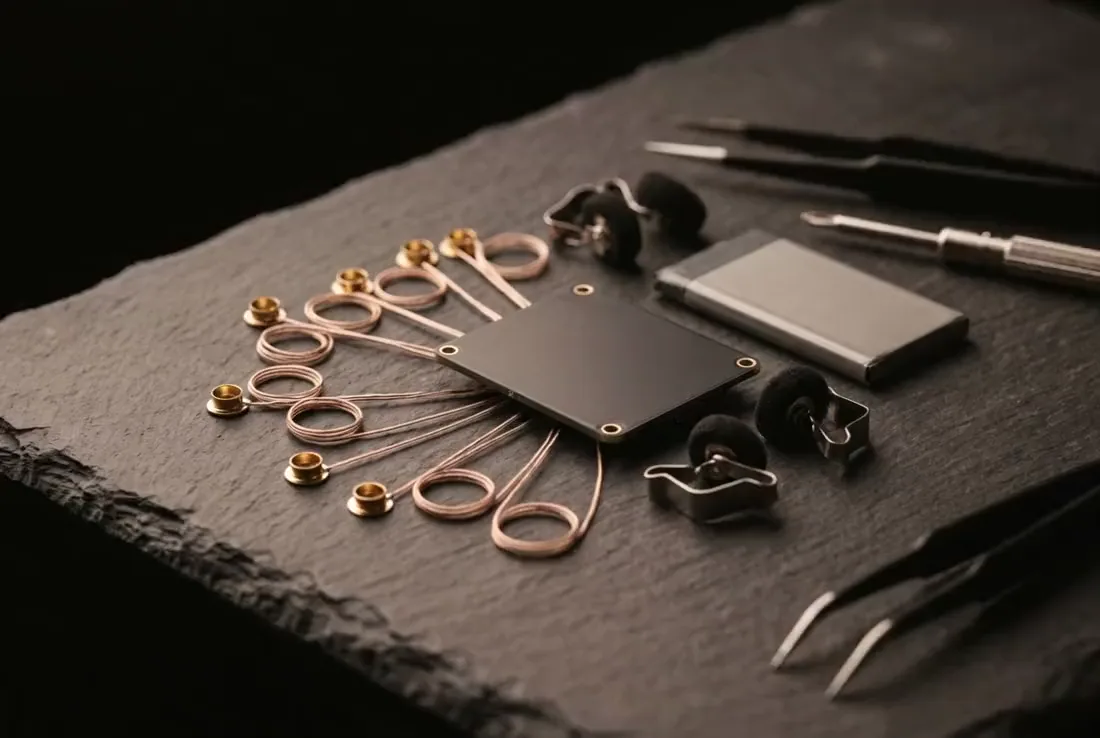
The listening core, as a concept film. The core itself is built and working on open hardware.
Three signals, one listener
A small set of sensors, placed by the guide, is all the Instrument has to go on. No camera, no microphone, no breathing belt.
The brain
A few sensors on the scalp read the brain’s rhythms, the same way a sleep laboratory does, at research grade.
The heart
One sensor reads the heartbeat itself, not a pulse at the wrist, so the timing of every beat is known.
The breath
The breath is read from the heartbeat, which rises and falls with every inhalation. Nothing is strapped to the chest.
Their coupling
What matters most is not any one signal but how they move together: breath with heart, heart with brain. That is the ground the map is drawn on.
One even field
Two layers of light, a steady ground of warm white and deep red and a white layer that carries the rhythm, are mixed inside a white cavity until no point of light survives. What reaches the closed lid is one even face that moves slowly in brightness and rhythm. Its colour holds steady; colour is never flashed.

The cavity, open, before the face is fitted. Concept image.
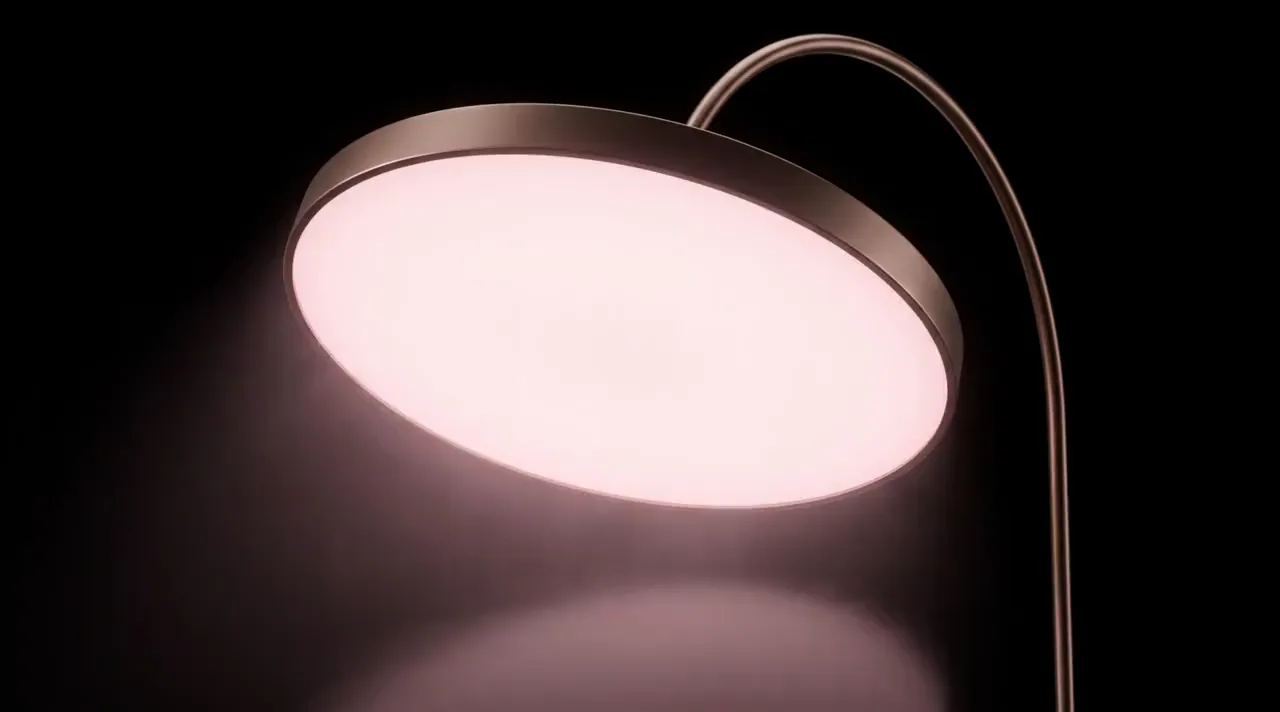
The face, its brightness moving as slowly as it does in a session. Concept render.
Evenness is a safety requirement before it is a style: patterned light is more provocative than an even field. The cavity, the coating and the diffuser exist for that reason first.
The loop
Sense, interpret, act, sense again. Everything else reports; this responds. The idea the patent application protects, stated as a principle.
- Three signals, one reading, on the device itself.
- The field withdraws with you, and comes back on signs of distress.
- The guide watches over it, and decides.
It reads
A session begins under warm, steady light. The journey’s rhythm arrives slowly, never all at once.
It shapes
The field answers: rhythm, depth and brightness, shaped to you while it is happening. As you settle it steps back, so that what you reach is yours and not the lamp’s.
It returns if needed
On signs of distress, the field warms and the guide is alerted. The guide, not the Instrument, decides what happens next.
The loop runs on the Instrument itself, as plain, auditable code, like a thermostat rather than a feed. There is no artificial intelligence in it, and it needs no internet connection to run. It keeps no score, shows no score and chases no score. Why it is built this way.
The limits, and why
Light over closed eyes carries real risks for a small number of people. We design against the current clinical consensus on visually provoked seizures, and we say plainly where the evidence runs out. What we know.
The ceilings on brightness and rhythm are part of the design and sit beneath every control.
The field is a diffuser: even, patternless, with no point of light. Evenness is a safety requirement here, not a style.
It runs on a battery, never from the wall.
Temperature is watched continuously; the light dims and then stops before anything becomes more than warm.
Every guest is screened privately with a questionnaire adapted from strobe-safety research, and first sessions are short and watched.
A stop control stays within the guest’s reach throughout; the guide can end a session at any moment and holds the final word.
The Instrument will be independently tested for optical safety before any release.
What the eye makes of it
Close your eyes under a soft, even light and the lid becomes a warm screen. When that light moves slowly in brightness and rhythm, the visual cortex answers with shapes and colours of its own: tunnels, spirals, lattices, cobwebs, rings around a point. Klüver named them the form constants in the 1920s. Bressloff and colleagues showed in 2001 that they come from the wiring of the primary visual cortex itself; Allefeld and colleagues catalogued in 2011 which of them flickering light brings.
They are the same family of shapes the contemplative traditions drew from the inside: the rings and triangles of the yantra, the mandala, the rose window. The light itself stays warm white and deep red and never flashes colour; much of the colour people meet behind closed eyes is made by the visual system itself. Each Shripur journey chooses a rhythm for the light and a yantra to contemplate before and after it, so that what the eye makes on its own has a name and a place to return to.
Many people see these shapes under the field; some see only colour; a few see little. All three are the path, and none is promised. What we know · One map, many hands
The map, read between sessions
The Instrument is the means. The map is what lasts.
After a session, with the person’s consent, the signals, the journey and the person’s own words are read together to draw a map of how they, in particular, go inward: which journeys open them, what settling looks like for them, what their return looks like. Over months, the map shows something no single session can: whether their resting ground is shifting.
Artificial intelligence helps draw the map. It works between sessions, never during one; it surfaces patterns for the guide and never speaks to a participant; and it never decides anything. A cartographer, not a controller.
Recordings stay on servers in India. Only derived features, never the raw signals, are sent out for the map to be drawn.
Open where it can be, ours where it matters
The sensing core is built on open hardware and open-source neuroscience tools, including BrainFlow and MNE-Python, and we will contribute back where we can. What is ours is everything above that layer: the method, the journeys and their yantras, the loop that withdraws, the per-person maps, the training of guides, and a dataset of guided sessions that grows with every one.
Designed and made in India. The listening core is built and working; the light field is in development. Patent pending, Indian application no. 202611124329.
The honest test
Does a light that listens and steps back take people deeper than one that does not? The comparison will run in the same room, with the same guide and journey, and the result will be published whichever way it falls.
Research and testing partners
We are looking for partners in India and Europe for the comparison study, for independent optical-safety testing, and for the study of contemplative states more broadly. Laboratories, universities and retreat houses with a research interest are welcome.