The Path
An old map of consciousness, drawn exactly, for the person who exists now.
Nine enclosures lead from the world at the gate to a single point at the centre. The map comes from India’s contemplative texts on sacred geometry. Shripur carries it into the forms a life can hold today: texts and manuals, retreats and workshops, an instrument of light, an app, and objects to carry.
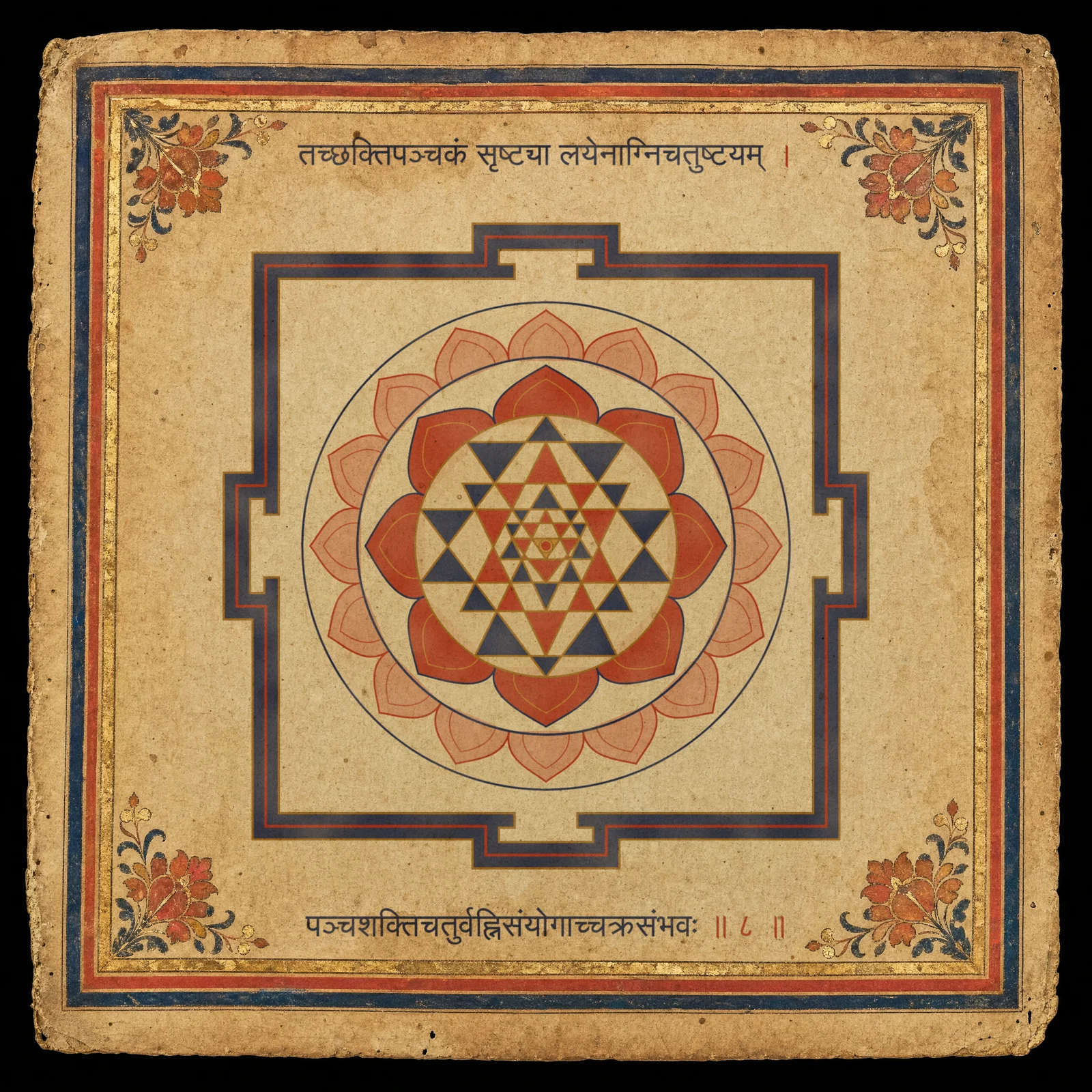
तच्छक्तिपञ्चकं सृष्ट्या लयेनाग्निचतुष्टयम् ।
पञ्चशक्तिचतुर्वह्निसंयोगाच्चक्रसंभवः ॥
Five triangles of power by way of emanation, four of fire by way of dissolution: from their union the cakra arises. Yoginīhṛdaya 1.8
Unit circle, after Pustynski 2014, Table 1
Form, so that the formless can be known.
Awareness itself has no shape, no edge and no place. The old teachers did not pretend otherwise. They drew it a shape anyway, so that attention would have somewhere to stand.
“As ghee hardens, as molten gold becomes a solid mass, so I give bodily form to the space of consciousness …”
Subhagodayavāsanā 36, quoted by Amṛtānanda in his commentary on the Yoginīhṛdaya
The commentary is direct about it. Awareness in its pure state cannot be known; through the cakra it can. Read without belief, that is an instruction any person can try: give attention a precise form to rest in, and follow it inward.
Nine enclosures, from the gate to the point.
The order and the names are the Yoginīhṛdaya’s (1.80–84), read with Amṛtānanda’s commentary. It gives every name the same last meaning: rest in what is not two.
The outer three
How the world arises. In the commentary these three are emanation: the squares, the sixteen petals and the eight.
त्रैलोक्यमोहन
Trailokyamohana, ‘enchanter of the three worlds’
The three worlds, says the commentary, are what is known, the means of knowing and the knower: the world, the senses and the self you arrive with. The path begins at the gate by noticing all three. The name says it enchants them; here they begin to blur into one.
सर्वाशापरिपूरक
Sarvāśāparipūraka, ‘fulfiller of all hopes’
Hope, in the text, is the longing of someone unsatisfied for something else. It is answered here not by getting more, but by a fullness that lacks nothing.
सर्वसंक्षोभण
Sarvasaṃkṣobhaṇa, ‘agitator of all’
A stirring that runs the other way. Level by level, from the earth upward, the many draw in, and the world of difference begins to dissolve.
The middle three
How it is held. The fourteen corners and the two rings of ten are maintenance.
सर्वसौभाग्यदायक
Sarvasaubhāgyadāyaka, ‘bestower of all good fortune’
Good fortune, the commentary says, is to be desired by all. This enclosure opens onto what everyone longs for: the abode of the highest love.
सर्वार्थसाधक
Sarvārthasādhaka, ‘accomplisher of all aims’
Every practice has one aim. The commentary borrows a poet’s image for it: the many paths fall into one, as rivers fall into the ocean.
सर्वरक्षाकर
Sarvarakṣākara, ‘protector of all’
Protection here is not a wall. It is the sense of “I” known as light, in which whatever seemed set against you dissolves.
The inner three
How it returns. The eight corners, the triangle and the point are withdrawal.
सर्वरोगहर
Sarvarogahara, ‘remover of all ills’
The text is plain about which ills it means: the thoughts that divide. In this enclosure division quiets, and what is not divided is recognised.
सर्वसिद्धिमय
Sarvasiddhimaya, ‘made of all accomplishment’
Three sides, three movements: arising, abiding and dissolving. The commentary calls the triangle the cause of all three. Everything begins, holds and returns here.
सर्वानन्दमय
Sarvānandamaya, ‘made of all bliss’
A point with no size, at the exact centre of the circle: light, and light aware of itself, as one. Every name before this one points here.
Two directions
Drawn from the point outward, the map shows how experience arises. Drawn from the gate inward, it is the way back. The text teaches both and no third: you begin at the edge or at the centre, never in the middle (1.77–78). Shripur walks it inward.
A map, not a scoreboard
No one is placed on it. The Instrument never tells you which enclosure you are in, and nothing in Shripur turns the nine into levels to reach. The map is for orientation, and for your guide. The walking is yours.
Draw it in the text’s two orders.
Choose a direction and the map is built one enclosure at a time: from the gate inward, the way back, or from the point outward, the way experience arises.
Then look at the proof. Show the points where three lines pass through one point, and the ten corners that touch the circle. Move any line by a hair and they stop meeting. That is why an exact Śrī Cakra is so rarely drawn by hand, and why ours is computed.
Three ways of seeing the same map.
The text asks for the cakra to be contemplated three times over, each finer than the last (1.27–34). It is the shape of the tradition’s ascent: from form, through finer and finer form, to what has none.
सकल
With parts
sakala
The eight enclosures from the squares to the triangle, felt in the body, from its base to the point between the brows.
सकलनिष्कल
With and without parts
sakalaniṣkala
Above the brow, nine subtle stations of sound, each lasting half as long as the one before, until the mind passes beyond.
निष्कल
Without parts
niṣkala
The great point: pure, open awareness, free of place, time and form.
The halving ladder
The nine stations of the middle way, with the length of each in mātrās, the time it takes to say a short vowel (1.28–34). The bars are drawn to scale.
shining like a lamp
the same light
like moonlight
with the lustre of a jewel
blazing like lightning
like twelve suns risen at once
like twelve suns risen at once
the last station where mind remains
no measure: the mind has passed beyond
Beyond the last station the commentary places the great point, which has no shape, form, colour, sound or time. Nothing in Shripur places you on this ladder; it is here as the tradition drew it.
One map, six ways in.
One path, carried into every form a life can hold: something to read, something to practise, somewhere to go, a light to lie under, a daily habit and something to wear.
Texts
The source, translated
The texts the map comes from, with their classical commentaries, in plain English. The Yoginīhṛdaya with Amṛtānanda’s commentary comes first.
The booksManuals
The practice, written down
Training manuals that carry the path step by step, for the people who walk it and for the guides who hold it.
The AcademyJourneys
Walked with a guide
Journeys and workshops in houses chosen for quiet, where the map is practised in person, from the gate inward.
The journeysThe Instrument
Form that makes way
A field of warm light that reads breath, heart and brain, goes inward with you and recedes as you settle: the map’s own movement, from form toward what has none.
The InstrumentThe app
Every day, at home
The daily sitting, the yantras and the texts, and what your guide shares with you between journeys.
At homeObjects
The map, worn
Sri Protocol: the whole Śrī Cakra in raised lines, exact to the coordinates, worn as a tag in silver, gold, brass and black.
The objectsRooted, and open to anyone.
The map comes from Śrī Vidyā, the Indian tradition of the Śrī Cakra, and stands in the older Vedic line of sacred geometry, from the fire altars of the Śulba Sūtras to the Bhāvanopaniṣad. We name every source, translate it and cite it.
You do not need to hold any belief to walk the path. It asks for attention, not faith. Where the texts speak of the goddess, the commentary itself reads her as one’s own awareness, and that is how we teach it.
यस्य विज्ञानमात्रेण त्रिपुराज्ञानवान् भवेत्
“By merely understanding it, one comes to know Tripurā.” Yoginīhṛdaya 1.79
Sources
Yoginīhṛdaya, with the Dīpikā of Amṛtānanda
Edited by Vrajavallabha Dviveda (Delhi: Motilal Banarsidass, 1988). The order, names and readings of the nine enclosures, the two directions and the three ways of seeing on this page come from it. Our English study edition is in draft, awaiting a Sanskritist’s final review.
Subhagodayavāsanā, verse 36
The image of ghee and molten gold, as the Dīpikā quotes it.
Bhāvanopaniṣad
The Śrī Cakra read as a map of the body and the mind. In translation.
Tantrarāja Tantra
A major tantra of the tradition’s practice. In translation.
Vijñāna Bhairava
A hundred and twelve contemplations; the source of the Śūnya journey.
Śrī Lalitā Sahasranāma
The Thousand Names: a commentary by R.K. Luthra. In print.
The geometry
V.-V. Pustynski, “On mathematical complexity of Śrīyantra”, Indian Journal of History of Science 49.3 (2014), 268–277, Table 1. Every Śrī Cakra on this site is drawn from its coordinates; the forty-three small triangles are found by computation, not by hand.
Begin at the gate.
The first door is a Discovery journey, walked with a guide in India from 2027.